

“Why is my smart kid failing math?” If you have typed that into a search bar — probably late at night, probably after another homework battle — I want you to know two things before anything else. First: this is one of the most common situations I saw in my years as a classroom teacher, and it says nothing bad about your child or your parenting. Second: it is almost always fixable, because a smart kid failing math is nearly never a math-ability problem. It is a signal that something specific and findable is in the way.
Let me walk you through the six causes I have seen over and over, how to tell which one you are looking at, and what actually helps — including what usually makes it worse.
Why intelligence doesn’t protect kids from math
Math is different from every other subject in one brutal way: it is relentlessly cumulative. A bright student can miss half the history unit and still ace the next one, because chapters of history stand on their own. Math chapters do not. Fractions feed into algebra, algebra feeds into functions, and a wobble three grades ago quietly taxes everything built on top of it.
Here is the part that fools everyone: smart kids are exceptionally good at compensating. They reason around gaps, pattern-match their way through homework, and pass tests on raw intelligence — right up until the load gets too heavy. That is why the wheels so often come off suddenly, in algebra or geometry, after years of “fine.” The failure looks new. The gap is usually old.

The six real reasons a smart kid fails math
1. A foundation gap that finally got heavy
The most common cause by far. Somewhere back down the line — a rough teacher year, a school switch, the fractions unit during a distracted spring — something didn’t solidify. Intelligence carried them past it, until the course load finally exceeded what reasoning-on-the-fly can cover. The tell: they understand new concepts in class but bleed points on execution, and their errors cluster in old skills (fraction operations, negative numbers, distributing) rather than the new topic.
2. The “fast equals smart” trap
Many bright kids grow up with speed as their identity: first done, never stuck. Then math gets hard enough that everyone gets stuck — that is what real math is — and they read normal struggle as proof they have stopped being smart. So they protect the identity instead: don’t try hard, and the failure doesn’t count. If your child says math is “boring” or “pointless” but gets tense around tests, you are often looking at fear wearing boredom’s clothes. (That fear has a name and a fix — here’s my full guide to helping a teenager with math anxiety.)
3. Working memory overload
Multi-step math leans hard on working memory — the mental scratchpad that holds “carry the one” while doing something else. A student can be highly intelligent with a modest scratchpad, and multi-step problems will punish them with “careless” errors that are anything but careless. I’ve written a full explainer on how working memory and long-term memory trade off in math — the short version is that the fix is building fluency so basics stop consuming the scratchpad, plus writing everything down.
4. Attention and executive function
Some very capable students lose points not to understanding but to execution: attention drifting mid-problem, skipped steps, unfinished homework that was 90% done. If that pattern sounds familiar — especially alongside “knows it at home, fails it at school” — read my guide on math tutoring for ADHD students. The structure that helps those students helps every distractible teenager, diagnosis or not.
5. A masked learning difference
This one hides longest in bright kids, precisely because they compensate so well. If basic number sense is effortful — estimating, comparing quantities, retaining math facts that simply will not stick despite real effort — it is worth ruling out dyscalculia, a learning difference that has nothing to do with intelligence. Here is what that looks like and how tutoring works for it. A psychoeducational evaluation through the school is the definitive answer.
6. The course hit a cliff
Some failure is simply structural: certain courses contain cliffs where the nature of math changes. Algebra 2 stops rewarding memorized steps the moment factoring becomes the entry ticket to every chapter, and geometry stops being about numbers at all when transformations and proofs arrive. A student who was taught procedures without understanding hits these cliffs hard — and it looks like sudden failure when it is really deferred cost coming due.
What to do first (before hiring anyone)
- Lower the temperature. Grades talk is threat talk to a kid whose identity is on the line. One sentence changes the frame: “This isn’t about the grade — I want math to stop being miserable for you.”
- Diagnose before you drill. Sit beside them for twenty minutes while they do homework, and just watch. Where exactly does it break — reading the problem, choosing an approach, or executing steps? Old skills or new ones? The location of the breakdown is the diagnosis.
- Ask, don’t re-explain. “Walk me through what you did” reveals more in five minutes than an hour of re-teaching — and it is how they rebuild trust in their own reasoning. (This is the Socratic approach I use in every session, and parents can do a version of it at home.)
- Talk to the teacher with a specific question. Not “how can they improve” but “where do you see the errors cluster?” Teachers see patterns parents can’t.
- Do NOT pile on more of the same. More worksheets attack the symptom. If the cause is a foundation gap, anxiety, or attention, extra volume of the thing that is failing them teaches exactly one lesson: math means suffering.
When it’s time for outside help
You can absolutely try the steps above first. Bring in a professional when the breakdown point isn’t findable at home, when homework has become a nightly conflict that is damaging your relationship, or when the gap is old enough that patching it needs someone who can see the whole staircase. What to look for in that person — and honest words about when a tutoring center or an app is the better buy — is in my comparison of the tutoring options. The short version: a bright kid who is failing needs diagnosis and dialogue, not drill — which is the case for one-on-one help with someone experienced.
Frequently asked questions
Q: Is my child just lazy?
A: In my experience, almost never — “lazy” is usually what avoidance looks like from the outside. Kids avoid math when it reliably makes them feel incapable. Fix the capability and the “laziness” tends to evaporate.
Q: Should I punish bad math grades?
A: If the cause is a gap, anxiety, or a learning difference — and it nearly always is — punishment adds pressure to a problem pressure makes worse. Consequences for genuinely skipped work are reasonable; consequences for struggling are counterproductive.
Q: Can a smart kid really have a math learning difference?
A: Yes — and bright students hide them longest, because they compensate with reasoning. Dyscalculia and ADHD both occur across every level of intelligence. That is exactly why the sudden-failure pattern in a smart kid deserves a real look rather than a “try harder.”
Q: How long does it take to turn math around?
A: The feelings move before the grades: less homework conflict within weeks, willingness to attempt problems in a month or so, then marks follow. A specific gap can close in a handful of targeted sessions; an old compounding one takes a semester of steady work. Anyone promising a jump in two weeks is guessing.
The bottom line
A smart kid failing math is a solvable mystery, not a verdict. Find which of the six causes you are looking at, take the pressure off while you do, and get targeted help for the actual cause rather than more volume of what is already failing. If you want a second pair of eyes on the diagnosis, that is literally what my first conversation is for — it is free, and I will tell you honestly what I think is going on, including when the answer is “you can fix this at home.” Reach out here or see how sessions work.
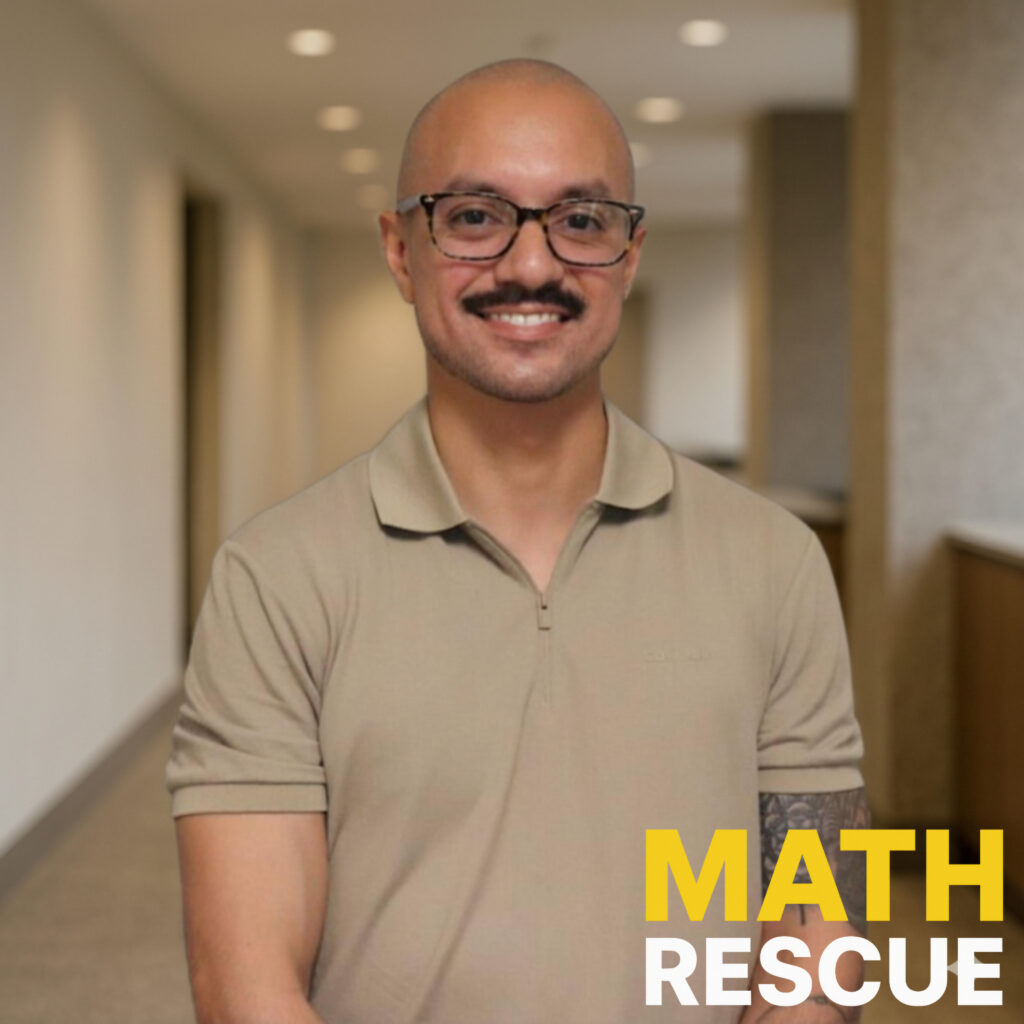
About Andre Vaquero, M.Ed.
Certified math educator and curriculum designer with advanced training in instructional technology. I’ve taught since 2017, both in-person and online, and specialize in turning abstract math into clear, visual steps students actually enjoy.
My mission is to help families build math confidence together — one skill at a time.
- B.S., Mathematics Education, 2017
- M.Ed., Curriculum and Instruction, specialization in math and instructional tech, 2019
- Graduate Certificate in Mathematics, 2021
- Classroom teaching since 2017, virtual teaching since 2021
I help middle school, high school, and college students master the exact skills that block progress, then build durable habits parents and students can sustain at home.
Serving families in St. Petersburg and online nationwide.