
Searching for a math tutor for ADHD students is a different problem than searching for a math tutor. Plenty of tutors know math; far fewer understand why a bright, capable kid with ADHD can ace a concept on Tuesday and stare at it like a stranger on Thursday. As a former classroom teacher, I want to walk you through what ADHD actually does to math learning, why the standard tutoring formats often make it worse, and what a session that genuinely works looks like — so you can evaluate any tutor, including me.
What ADHD does to math, specifically
Math is uniquely punishing for ADHD brains, and it is not because of intelligence. Math stacks three demands that ADHD makes expensive:
- Sustained attention across multi-step problems. A three-step equation gives three chances for attention to drift, and a drift at step two silently corrupts step three. The result gets marked as a “careless error,” but there was nothing careless about it — the student was working hard the whole time.
- Working memory. Holding “carry the 1” while doing something else is a working-memory task, and ADHD taxes exactly that scratchpad. (I’ve written about how working memory and long-term memory trade off in math — it applies doubly here.)
- Delayed reward. Math’s payoff — the satisfaction of a solved problem — arrives at the end of sustained effort. ADHD brains under-respond to delayed rewards, which is why a student who can hyperfocus on a game for three hours cannot push through ten minutes of homework. It is neurology, not character.
The cruelest part is the label that follows: “careless,” “lazy,” “doesn’t apply himself.” Years of that teaches a student that math is where they get exposed — and then anxiety joins the party, compounding everything.
In my classrooms, these were never the kids who couldn’t do math — they were the kids whose executive function needed scaffolding the classroom didn’t provide. They could move; they just needed support and a reminder, at the right moment, to move. The hard part was watching adults read a support need as a character flaw: the students everyone called unmotivated were often working harder than anyone else in the room, just to do what came free to their classmates.
Why worksheets, drill centers, and hour-long lectures backfire
The default tutoring formats are close to worst-case for ADHD. Drill-heavy programs hand the student a stack of repetitive problems — repetition is exactly what an ADHD brain disengages from fastest. Learning-center formats leave students semi-supervised with worksheets for most of the visit, which for an ADHD student means most of the visit is lost to drift. And a tutor who re-explains for forty minutes while the student nods politely is delivering a lecture to someone whose attention left the room at minute six. (I compare these formats honestly in my guide to Mathnasium alternatives — for ADHD students the format question matters more than the brand.)
What actually works for ADHD students
Short cycles, immediate feedback
Instead of twenty problems then checking, we work in tight loops: one problem, immediate feedback, next problem. Every loop is a small completed mission with a payoff at the end. This single structural change converts math practice from a delayed-reward slog into the kind of rapid feedback cycle ADHD brains genuinely engage with.
The tutor as body double
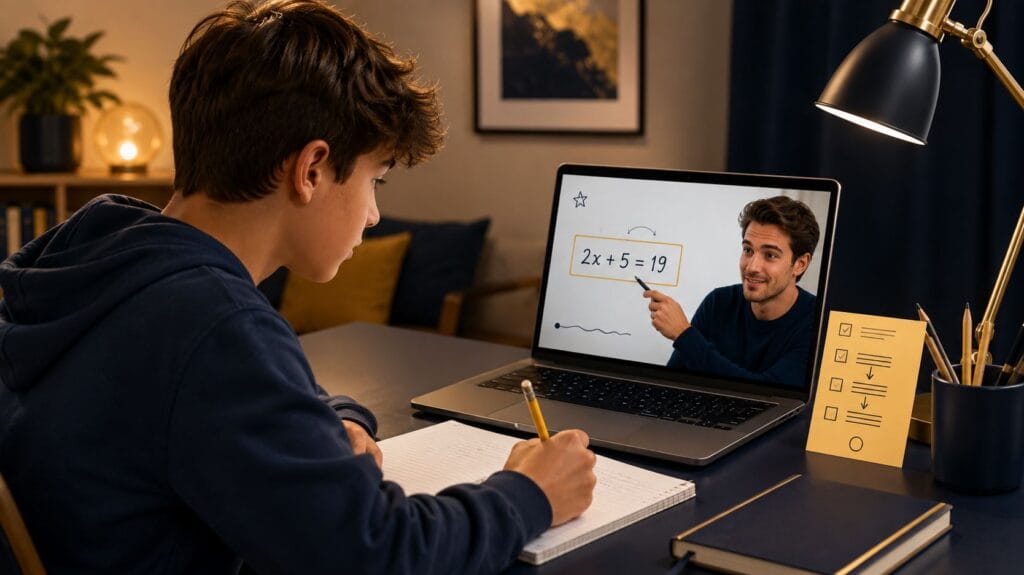
People with ADHD focus dramatically better when someone is working alongside them — the strategy is called body doubling, and one-on-one tutoring is body doubling with expertise attached. The tutor’s presence does half the attention-regulation work before any math is discussed. This is also why group formats lose exactly what an ADHD student is paying for.
Externalize the working memory
Everything the brain would juggle gets written down instead: a visible steps card, scratch work for every problem (non-negotiable, and never framed as remedial), graph paper to keep place value honest, formulas on the wall not in the head. The working-memory scratchpad is freed for the actual thinking.
Dialogue, not lecture
An ADHD student who is answering questions cannot drift, because the ball keeps landing back in their court. This is why I run every session Socratically — the student does the thinking out loud. It doubles as an attention technology: engagement through participation beats engagement through willpower every time.
Momentum over marathon
Two or three shorter sessions beat one long one. Attention is a budget; we spend it where it counts and stop while the student is still winning. Ending on a success is not soft — it is what makes them willing to come back.
The way I think about my role with these students is bumper lanes at a bowling alley. They supply all the power and all the aim — my job is a well-timed reminder, a small motivation hack, a nudge that keeps the ball out of the gutter. And when the ball keeps reaching the pins, session after session? These kids are incredible.
Does online tutoring work for ADHD students?
Honestly: it depends on the session design, not the format. Online works well when the session is genuinely interactive — shared whiteboard, the student writing and talking constantly, camera on, short cycles. It fails when it is a talking head over a worksheet. Home has distractions, but it also removes the transition battle of getting an ADHD kid to one more appointment, and familiar surroundings lower the baseline stress. (It’s part of why online tutoring fits homeschool families so well — the format bends around the student, not the other way.) My sessions are built for the interactive version — and if your child also struggles with the number-sense side of math, the approach overlaps heavily with how I tutor students with dyscalculia (the two frequently co-occur).
How to evaluate a math tutor for ADHD students
- “What does your session structure look like?” Listen for short cycles and student participation — not “we go through their homework.”
- “How do you handle it when a student loses focus mid-session?” A good answer treats drift as information (change the activity), not misbehavior (repeat the instruction louder).
- “Will you use my child’s 504/IEP accommodations?” Extended time, calculator use, reference sheets — sessions should practice the way your child will actually be assessed.
- “How will we know it’s working?” Look for behavior-first answers: fewer homework battles, attempts problems independently, talks about math without dread. Grades follow.
One boundary worth stating: I am a math educator, not a clinician. Tutoring complements — never replaces — whatever medical or therapeutic support your family has chosen, and I make no recommendations on that side. If you want a deeper clinical picture of ADHD and learning, CHADD is the standard parent resource.
ADHD math tutoring FAQs
Q: How long should tutoring sessions be for an ADHD student?
A: Shorter and more frequent wins. Thirty to forty-five focused minutes, two or three times a week, beats a single ninety-minute marathon that spends its second half fighting attention fatigue.
Q: My child knows the material but fails tests. Can tutoring fix that?
A: Often, yes — because the gap is usually execution, not knowledge: attention drift on multi-step problems, working-memory overload, and time pressure. We train exam mechanics (showing every step, checking against the rules, pacing) as explicitly as the math itself.
Q: Should I tell the tutor about my child’s ADHD diagnosis?
A: Yes. A tutor who knows can structure sessions to work with your child’s attention instead of against it. A tutor who reacts badly to the information just saved you months of wasted fees.
Q: Is ADHD the same as dyscalculia?
A: No — ADHD is an attention-regulation difference and dyscalculia is a number-processing difference — but they co-occur often, and both punish multi-step math. If basic number sense (estimating, comparing quantities) is also hard for your child, it is worth reading about the dyscalculia side too.
Where to go from here
If this sounded like your kid, the fix is not more pressure — it is better structure. That is the entire job of a good math tutor for ADHD students. I tutor one-on-one online, sessions are built exactly the way this article describes, and the first conversation is free: tell me what you are seeing and I will tell you honestly whether I am the right fit. Reach out here or see how sessions work.
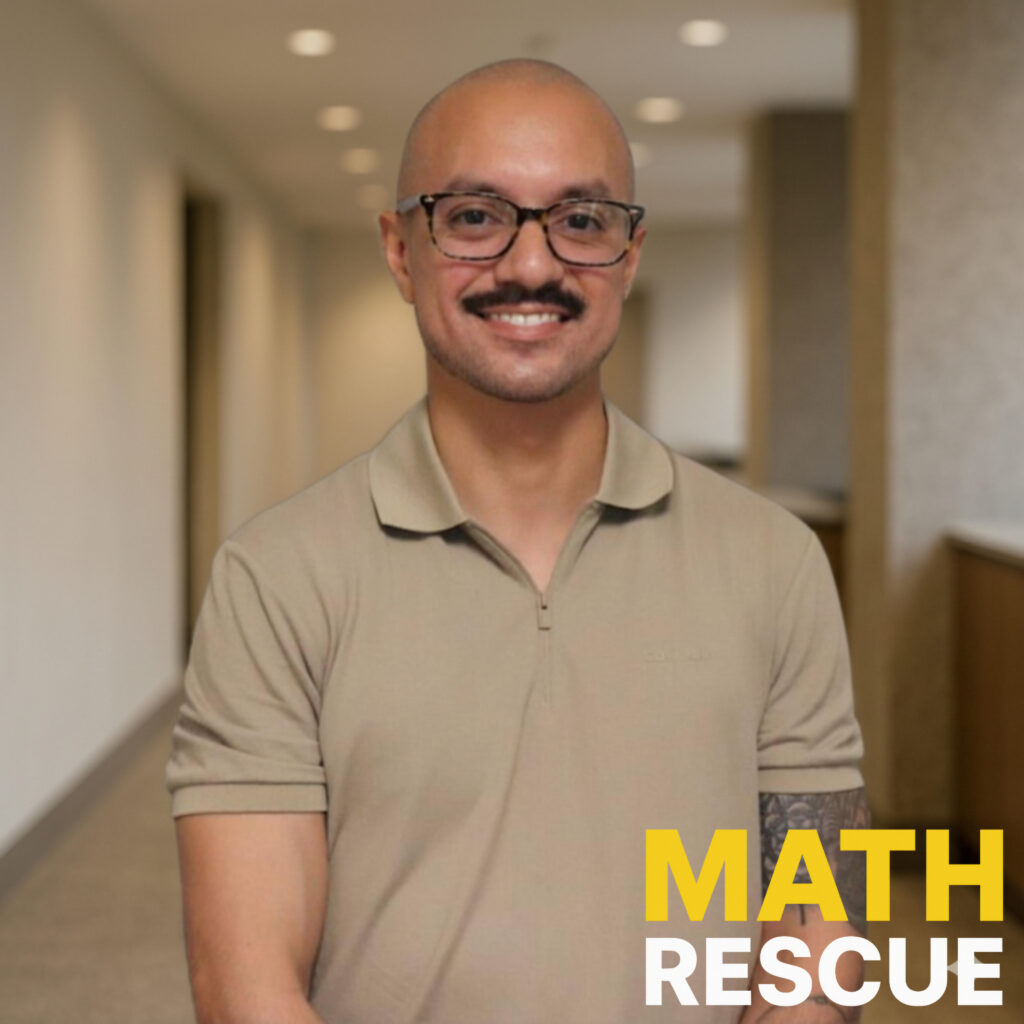
About Andre Vaquero, M.Ed.
Certified math educator and curriculum designer with advanced training in instructional technology. I’ve taught since 2017, both in-person and online, and specialize in turning abstract math into clear, visual steps students actually enjoy.
My mission is to help families build math confidence together — one skill at a time.
- B.S., Mathematics Education, 2017
- M.Ed., Curriculum and Instruction, specialization in math and instructional tech, 2019
- Graduate Certificate in Mathematics, 2021
- Classroom teaching since 2017, virtual teaching since 2021
I help middle school, high school, and college students master the exact skills that block progress, then build durable habits parents and students can sustain at home.
Serving families in St. Petersburg and online nationwide.