
If you’re weighing Mathnasium alternatives, you’re probably not anti-Mathnasium — you’re a parent doing due diligence before committing a few hundred dollars a month to your kid’s math. Good instinct. I’m a former classroom teacher who now tutors privately, which means two things: I have a horse in this race and I’ll tell you so, and I’ve also seen enough students come from every one of these programs to tell you honestly what each does well and where each falls short.
Short version: the right choice depends almost entirely on why your child is struggling and how old they are. The longer version is below, with a comparison table and specific recommendations by situation.

The main Mathnasium alternatives, honestly described
Mathnasium (learning centers)
What it is: franchise learning centers where students work through Mathnasium’s own curriculum, guided by instructors who float between several students at once. Typically sold as a monthly membership (commonly in the $200–$400/month range for 2–3 visits per week, varying by location).
Where it shines: elementary and middle schoolers who need consistent, structured practice and benefit from a routine of “going to math” the way they’d go to soccer practice. The curriculum is genuinely solid at diagnosing and filling arithmetic gaps.
Where it falls short: the instructor-to-student ratio. Your child gets minutes of direct attention per visit, not the full hour — the rest is independent worksheet time. That works for practice-gap kids. It works far less well for high schoolers in algebra 2 or precalc, where the sticking points are conceptual and need real dialogue, and for students with learning differences or math anxiety, who tend to quietly drown in semi-independent formats. Instructors also vary a lot by location — often bright college students, rarely experienced teachers.
Kumon
What it is: a worksheet-mastery system — short daily packets, repetition until fast and accurate, advancing in small increments. Usually cheaper (commonly $150–$250/month per subject).
Where it shines: building computational fluency and daily discipline in younger students. A second grader who does Kumon faithfully will almost certainly compute quickly.
Where it falls short: Kumon teaches procedures through repetition, not understanding through reasoning — and by high school math, understanding is the whole ballgame. It’s also the single most common source of math burnout I see: the daily-packet grind can turn a kid who disliked math into one who resents it. And for a student who’s already anxious or has a learning difference, drill-until-fluent is precisely the approach that backfires.
Online platforms and apps (Khan Academy, IXL, etc.)
What they are: self-serve video lessons and practice problems. Khan Academy is free and genuinely good; IXL and similar run modest subscriptions.
Where they shine: motivated, self-directed students patching a specific known gap (“I never got logarithms”). As a supplement, I recommend them to my own students constantly, and many homeschool families use them as the daily spine with a tutor for the sticking points.
Where they fall short: the students who most need help are almost never the self-directed ones. A video can’t notice your child chose it for the wrong reason, can’t hear the flawed reasoning behind a right answer, and can’t rebuild confidence. Free is only cheap if it gets used.
Private 1:1 tutoring (in person or online)
What it is: the full session, one student, one tutor. Rates vary enormously with experience — roughly $30–$120+/hour, with credentialed, experienced teachers toward the upper-middle of that range.
Where it shines: everything that requires actually knowing your kid. Conceptual sticking points in upper math, test anxiety, learning differences, college-entrance prep, and the fastest turnaround per hour spent — because every minute is aimed at your child’s actual gap, not a curriculum’s average of it. The tutor adapts in real time, which no packet or center ratio can.
Where it falls short: the highest per-hour price, and quality varies wildly — “tutor” is an unregulated word, and a cheap tutor who just re-explains like the classroom did is money burned. Interview before you commit (questions below).
Side-by-side comparison
| Mathnasium | Kumon | Platforms (Khan/IXL) | Private 1:1 tutor | |
|---|---|---|---|---|
| Typical cost | $200–400/mo | $150–250/mo per subject | Free–$20/mo | $30–120+/hr |
| 1:1 attention | Minutes per visit | Minimal | None | The entire session |
| Adapts to your child | Curriculum-level | Pace only | Algorithmic | Fully, in real time |
| Best ages | Elementary–middle | Elementary | Self-directed teens | All, strongest for high school |
| Conceptual help (algebra 2+) | Limited | Weak | Passive | Strongest |
| Math anxiety / learning differences | Mixed | Often counterproductive | Poor | Strongest (if experienced) |
| Parent visibility | Progress reports | Packet scores | Dashboards | Direct notes from tutor |
Pricing note: ranges reflect typical published rates for local, in-person programs, verified at the time of publishing (August 2026). Rates vary by location and change over time — always confirm current pricing directly with each provider.
Which should you pick? By situation:
- 2nd–6th grader, behind on arithmetic, no anxiety: Mathnasium or Kumon are legitimate choices — structure and repetition are what’s needed, and the price-per-month math works in their favor.
- Motivated teen with one specific gap: try Khan Academy first, seriously. If it’s still not clicking after a few weeks, that’s your signal the gap is conceptual — get a tutor.
- High schooler struggling in algebra 1/2, geometry, or precalc: private 1:1. This is where center ratios and worksheet systems run out of road — the fix is dialogue, and dialogue doesn’t scale.
- Any student with math anxiety, ADHD, or dyscalculia: private 1:1 with someone experienced in learning differences — here’s what that should look like. Drill-based formats tend to make these students worse, not better.
- Test prep (SAT/ACT) on a deadline: private 1:1. Time is the scarce resource; pay for precision.
The cost math parents usually miss
Compare cost per hour of direct attention, not per month. A $300/month center membership with ~15 minutes of true 1:1 time per visit, twice a week, works out to roughly $2.50 per minute of attention. A $60/hour private tutor is $1 per minute — every minute aimed at your child. Cheaper-per-month is not the same as cheaper-per-result; the expensive option is whichever one doesn’t work.
Frequently asked questions
Is Mathnasium worth it compared to a private tutor?
For elementary students needing structured practice: often yes. For high schoolers with conceptual gaps, anxiety, or a learning difference: usually no — the per-hour attention math favors a good private tutor, and the format matters more than the brand.
Kumon vs a private math tutor — which is better?
Different tools. Kumon builds computational speed in young kids through daily repetition. A private tutor builds understanding through dialogue. If your child’s problem is “slow at arithmetic,” Kumon is defensible. If it’s “doesn’t get it,” or math has become a source of dread, repetition without understanding tends to deepen the hole.
Are online tutors as good as in-person?
For math, with a shared whiteboard and a tutor who runs a visual, interactive session — yes, and you get a much larger pool of tutors to choose from than whoever happens to live nearby. The format matters less than the person. (All of my tutoring is online; here’s how sessions work.)
What should I ask before hiring any tutor?
Three quick filters: “What does a typical session look like?” (listen for the student doing the thinking — here’s why that matters); “How do you handle a student who’s anxious about math?”; and “How will I know it’s working before the next report card?” Vague answers to any of these — keep looking.
My honest pitch, since you’re here
I’m one of the Mathnasium alternatives: a former classroom teacher doing 1:1 online tutoring, strongest with middle and high schoolers — especially the “smart kid, suddenly failing algebra” cases and students who’ve started to hate math. If that’s your situation, the first conversation is free and I’ll tell you plainly if one of the cheaper options above would serve you better. Sometimes it would, and I’d rather tell you that than waste your money. You can also book a single on-demand session to try it with zero commitment.
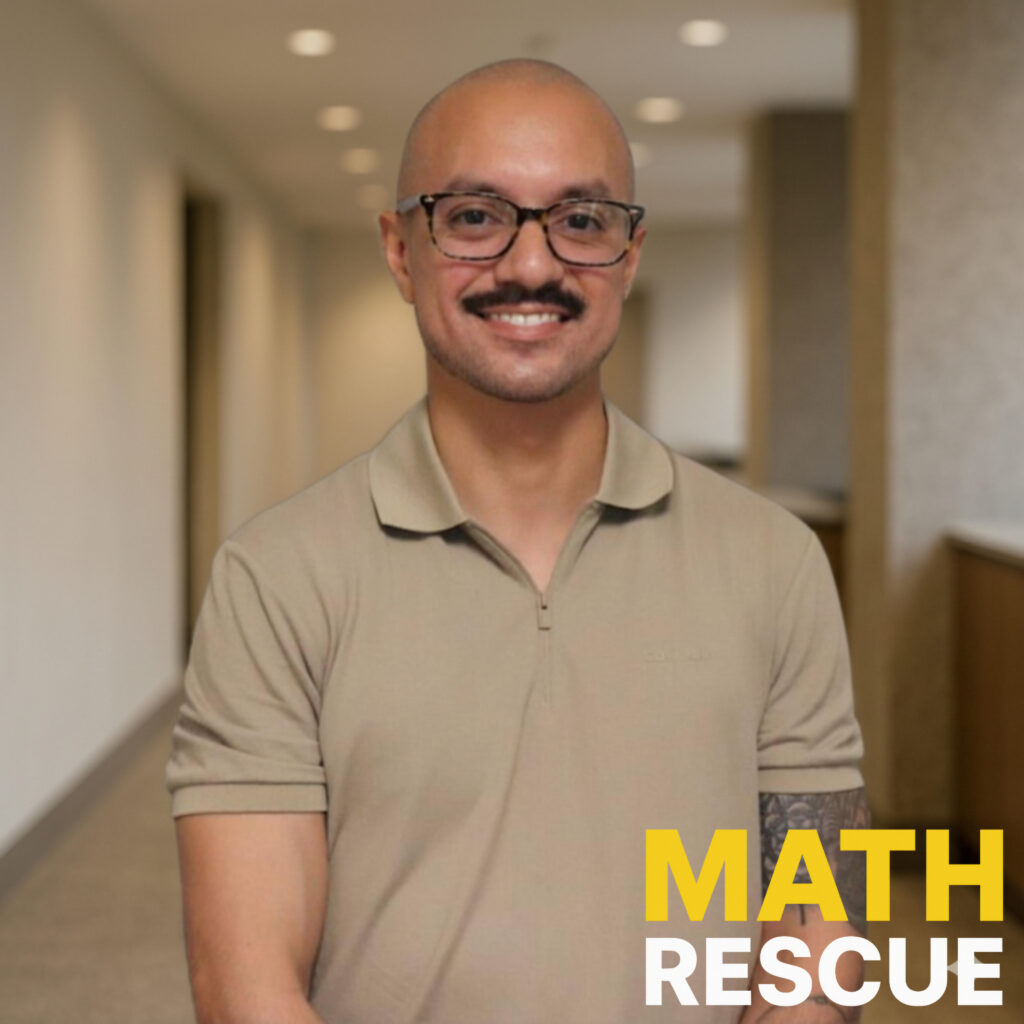
About Andre Vaquero, M.Ed.
Certified math educator and curriculum designer with advanced training in instructional technology. I’ve taught since 2017, both in-person and online, and specialize in turning abstract math into clear, visual steps students actually enjoy.
My mission is to help families build math confidence together — one skill at a time.
- B.S., Mathematics Education, 2017
- M.Ed., Curriculum and Instruction, specialization in math and instructional tech, 2019
- Graduate Certificate in Mathematics, 2021
- Classroom teaching since 2017, virtual teaching since 2021
I help middle school, high school, and college students master the exact skills that block progress, then build durable habits parents and students can sustain at home.
Serving families in St. Petersburg and online nationwide.