
If you’re searching for a math tutor for dyscalculia — or just starting to suspect your child needs one, you’ve probably already been through a lot: the tears over homework, the “careless” mistakes that aren’t careless at all, maybe a teacher who means well but doesn’t quite get it. As a former classroom teacher, I want to tell you two things up front. First: your child is not lazy, and they are almost certainly not “bad at math” in the way they’ve started to believe. Second: the right kind of tutoring genuinely helps — but it has to be the right kind, because ordinary tutoring often makes dyscalculic students feel worse.
This guide covers what dyscalculia actually looks like in real students, why typical tutoring approaches backfire, what an effective session looks like instead, and how to evaluate any tutor — me included — before you spend a dollar.
What dyscalculia is (and what it isn’t)
Dyscalculia is a specific learning difference that affects how the brain processes numbers and quantity. It’s often described as “dyslexia for math,” and while that’s imprecise, it captures something important: it is neurological, it is not about effort or intelligence, and it doesn’t go away by simply practicing harder. Researchers estimate it affects roughly 3–7% of students — which means most classrooms have at least one, and most teachers have never been trained to spot it. (If the term is new to you, Understood.org’s parent primer is a solid place to start.)
In real students, it tends to look like this:
- Counting on fingers long after peers have stopped — not as a habit, but as a genuine need
- Trouble judging quantities at a glance (which pile has more?) or estimating (“about how much is 38 + 41?”)
- Math facts that won’t “stick” no matter how many flashcards you run — 7 × 8 is a fresh problem every single time
- Losing their place in multi-step problems, or doing the steps in the wrong order
- Difficulty reading clocks, handling money, or judging elapsed time
- Deep math anxiety — because years of this quietly teaches a kid that math is where they fail
In my classroom years, the student I think of was rarely the one acting out. More often it was the quiet one who had mastered looking busy — still counting on fingers under the desk in middle school, erasing holes into the paper, homework that took three times longer than it should have. The tell was never the wrong answers. It was how much the right ones cost.
One important note: I’m a math educator, not a diagnostician. If you suspect dyscalculia and it hasn’t been formally identified, a psychoeducational evaluation (through your school district or privately) is worth pursuing — it opens the door to IEP or 504 accommodations, and it gives everyone working with your child a clearer map. Tutoring helps either way, but a diagnosis makes the whole support system stronger.
Why ordinary math tutoring often backfires
Most tutoring — and most tutoring centers — run on a simple model: figure out which procedures the student is behind on, then drill those procedures until test scores move. For a typical student who missed a few weeks of instruction, that works fine.
For a dyscalculic student, it’s exactly backwards. Their gap isn’t a missing procedure — it’s the number sense underneath the procedure. Drilling long division into a student who can’t yet feel that 42 is about half of 80 is like drilling spelling into a child who can’t yet hear the sounds in words. The student works twice as hard as everyone else, still fails, and draws the only conclusion available to them: “I’m stupid.” That belief does more long-term damage than any missed math fact.
There’s also a working-memory piece. Many dyscalculic students have limited working memory for numbers — the mental scratchpad where you hold “carry the 1” while doing something else. Multi-step procedures overload that scratchpad fast. I’ve written more about how working memory and long-term memory interact in math learning — it applies doubly here.
What actually works: how sessions should be different
Concrete first, always
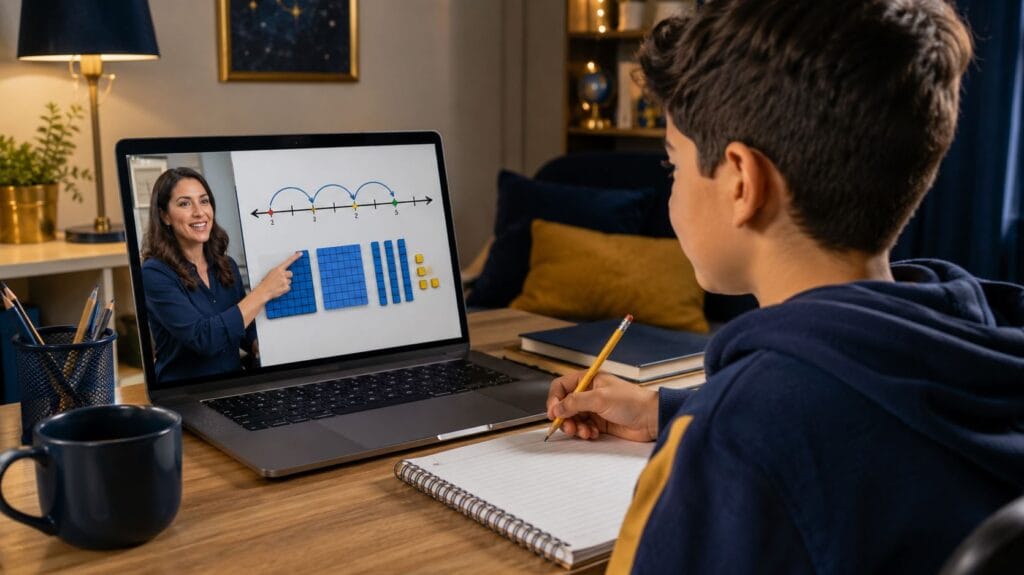
Effective dyscalculia tutoring follows what educators call the CRA sequence — Concrete, Representational, Abstract. We start with things you can see and move (number lines, area models, base-ten pieces, even in an online session with virtual manipulatives), then drawings and diagrams, and only then the bare symbols. Skipping to the symbols is precisely what school already tried.
Fewer facts, deeper strategies
Instead of memorizing 100 multiplication facts (which may simply never automatize), we build derived-fact strategies: if you know 7 × 7 = 49, then 7 × 8 is just one more 7. That’s not a crutch — it’s how mathematicians actually think, and it converts an impossible memory task into a small reasoning step the student can always rebuild.
Offload the working memory
Written procedure cards, always-visible number lines, graph paper for lining up place value, and — yes — a calculator for the arithmetic inside a bigger problem, so the student’s limited scratchpad is spent on the concept we’re actually learning. These are the same accommodations a good IEP specifies, and a tutor should use them without being asked.
Questions, not corrections
Dyscalculic students have usually been corrected thousands of times. What rebuilds them is being asked — “how did you get that?”, “what would happen if…?” — and discovering their reasoning is worth listening to. This Socratic approach is the core of how I tutor every student; I’ve written about why it works here. For students with a learning difference it’s not optional. It’s the whole game.
The moment I work for is the mid-sentence stop — a student halfway through explaining their thinking who suddenly goes quiet, and then: “wait… so it just breaks into sevens.” That pause is the sound of a kid discovering they can reason their way into math instead of memorizing their way around it. Their posture changes after that. Everything changes after that.
Does online tutoring work for dyscalculia?
Honest answer: yes — an online math tutor for dyscalculia can work very well, with two caveats. Online 1:1 works well because the session is inherently visual (shared whiteboard, virtual manipulatives, color, diagrams) and because many dyscalculic students are more relaxed at home than at a tutoring center that feels like more school. The caveats: it must be truly one-on-one — small-group “personalized” formats give a dyscalculic student the worst of both worlds — and the tutor must run a structured visual session, not just talk over a worksheet on camera.
How to evaluate any math tutor for dyscalculia (including me)
Ask these five questions. A tutor worth hiring will have real answers:
- “How would you approach a student who can’t retain math facts?” — Listen for strategies and number sense, not “more practice.”
- “What does a typical session look like?” — Listen for visuals, manipulatives, and the student doing the thinking.
- “How do you handle math anxiety?” — If they look blank, keep looking. Anxiety management is half this job.
- “Will you coordinate with the school / IEP accommodations?” — The answer should be an easy yes.
- “How will I know it’s working?” — Good answer: specific behaviors (attempts problems independently, explains reasoning, less homework conflict) before grades move. Grades follow; they don’t lead.
Realistic expectations
Progress with dyscalculia is real but not instant. In my experience the sequence looks like: first the homework battles shrink (weeks), then confidence and willingness to attempt problems returns (a month or two), then grades follow. A tutor promising a letter-grade jump in three weeks is telling you what you want to hear. What you should expect quickly is a change in how your child talks about math — that’s the leading indicator everything else follows.
Frequently asked questions
Can dyscalculia be “cured” with tutoring?
No — and be wary of anyone who says otherwise. Dyscalculia is a lifelong learning difference. What tutoring does is build compensating strategies, genuine number sense, and confidence, so the difference stops being a barrier. Plenty of dyscalculic students go on to succeed in algebra, statistics, even STEM careers — with tools that fit how their brain works.
How often should a dyscalculic student meet a tutor?
Twice weekly for 30–60 minutes beats one long weekly session — retention between sessions is the bottleneck, so shorter and more frequent wins. Consistency matters more than duration.
My child has an IEP/504. Does a private tutor use those accommodations?
A good one does, and asks to see the relevant parts. Accommodations like extended time, calculator use, and reference sheets should be built into sessions so your child practices the way they’ll actually be assessed.
Is it dyscalculia or just math anxiety?
They feed each other and often coexist. Rough distinction: anxiety alone usually spares basic number sense (the student can estimate and compare quantities when calm); dyscalculia affects it even in low-pressure settings. A psychoeducational evaluation is the reliable way to know — and tutoring that rebuilds confidence helps in either case.
Where to go from here
If ADHD is part of your child’s picture too — the two co-occur often — I’ve written a companion guide to math tutoring for ADHD students.
If this described your child, I’d genuinely like to help. I tutor one-on-one online, sessions are built around the approach described in this article, and the first conversation is free — tell me what you’re seeing, and I’ll tell you honestly whether I’m the right fit. Reach out here or look at how sessions work.
You know your child better than anyone; I know how math learning breaks down and how to rebuild it. Between us, that’s usually enough. — Andre
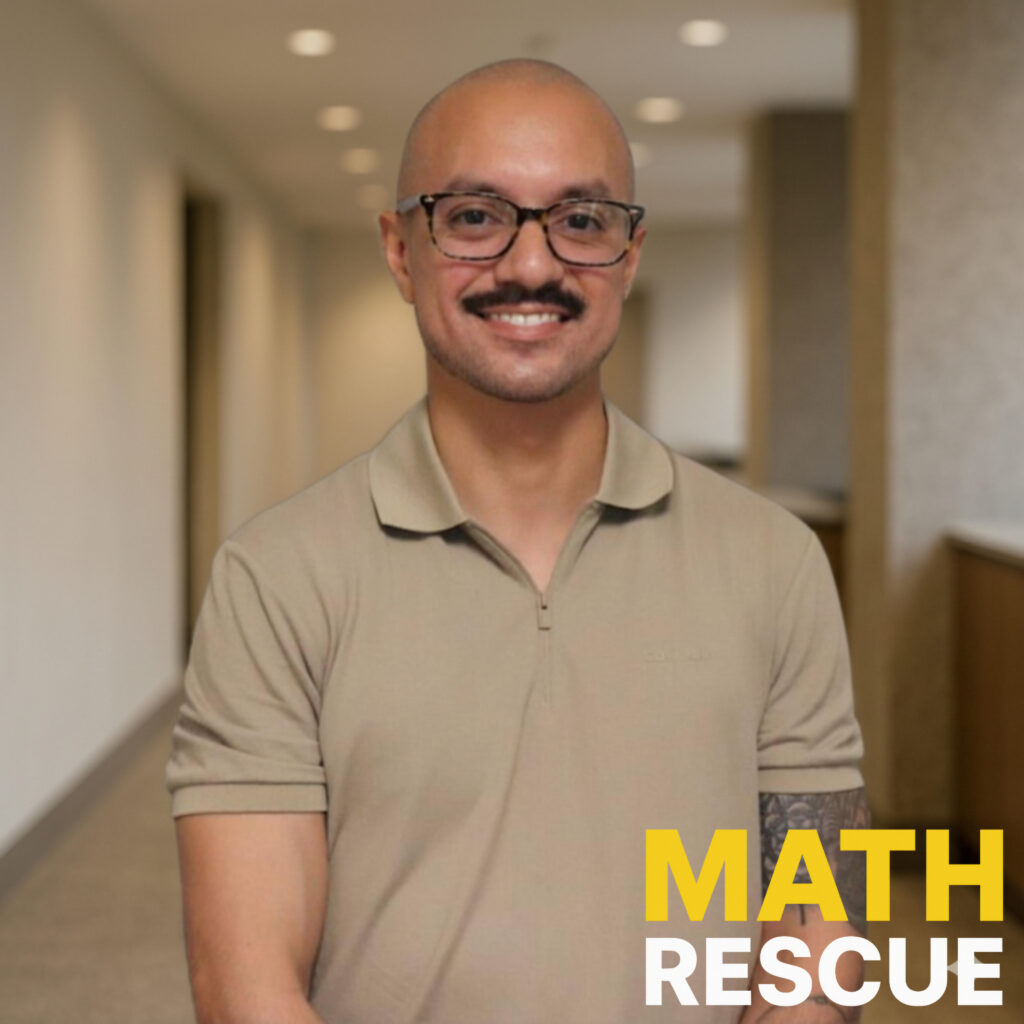
About Andre Vaquero, M.Ed.
Certified math educator and curriculum designer with advanced training in instructional technology. I’ve taught since 2017, both in-person and online, and specialize in turning abstract math into clear, visual steps students actually enjoy.
My mission is to help families build math confidence together — one skill at a time.
- B.S., Mathematics Education, 2017
- M.Ed., Curriculum and Instruction, specialization in math and instructional tech, 2019
- Graduate Certificate in Mathematics, 2021
- Classroom teaching since 2017, virtual teaching since 2021
I help middle school, high school, and college students master the exact skills that block progress, then build durable habits parents and students can sustain at home.
Serving families in St. Petersburg and online nationwide.