
Your teenager sits down to do math homework and within ten minutes there are tears, or slammed books, or the flat announcement: “I’m just bad at math.” Tests come back far below what you know they understand. Maybe they’ve started “forgetting” assignments entirely. If that sounds familiar, you’re likely not dealing with a math problem — you’re dealing with math anxiety, and those are different problems with different fixes.
I’m a former classroom math teacher (M.Ed.) who now tutors one-on-one, and math anxiety walks into my sessions every single week — usually wearing a disguise. This guide covers what it actually is, why it tends to peak in high school, and how to help a teenager with math anxiety in ways that work — plus the common responses that quietly make it worse.
Math anxiety is real — and it’s not the same as being bad at math
Math anxiety is one of the most-studied phenomena in math education: a fear response that switches on specifically around math tasks — homework, tests, being called on, sometimes just the sight of a problem. It shows up physically (racing heart, blank mind, dread on math-class days) and it is not a measure of ability. Plenty of genuinely capable students have it; some of the most anxious students I’ve taught were among the brightest.
Here’s the mechanism that matters: anxiety eats working memory — the small mental scratchpad math depends on more than any other subject. A worried brain fills that scratchpad with “what if I fail” instead of the algebra steps. So an anxious student genuinely can’t show what they know in the moment, scores badly, and takes the score as proof they’re bad at math. The anxiety causes the failure, then the failure feeds the anxiety.
Why math anxiety peaks in high school
Elementary math anxiety exists, but high school is where it compounds, for three reasons.

Math becomes unforgiving of gaps. Algebra stacks on arithmetic, Algebra 2 stacks on Algebra 1. A student who coasted through middle school on memorization can hit the wall hard — the classic smart kid suddenly failing math pattern — and the shock of that first real struggle is fertile ground for anxiety.
The stakes get loud. Timed tests, GPAs, graduation requirements, state exams like Pennsylvania’s Keystone Algebra 1 exam or Florida’s EOCs, the looming SAT. Pressure narrows attention, and narrowed attention is exactly what multi-step math punishes.
Identity hardens. Teenagers are deciding who they are, and “I’m not a math person” is one of the few academic self-labels our culture happily co-signs. Nobody says “I’m just not a reading person” at a dinner party. Once that label sets, avoidance feels rational: why invest in something you’ve decided you constitutionally can’t do?
The avoidance spiral
Anxiety’s favorite move is avoidance: homework done last and fastest (or “forgotten”), no questions asked in class, studying that is really re-reading notes with the answers visible. Avoidance brings instant relief, so it’s self-reinforcing — but every avoided problem is practice not done, so real gaps open where there was only fear before. By the time a parent sees the grade drop, the spiral has usually been running for months. The grade is the last symptom, not the first.
What doesn’t help (though we’ve all tried it)
“Just relax, you know this.” To an anxious brain this reads as “your distress is wrong,” which adds shame to fear. The feeling is real even when the danger isn’t.
More timed drill. Speed pressure is the single most reliable trigger for math-anxious students. Fluency matters, but it’s built with low-stakes, untimed practice first — racing the clock before confidence exists just rehearses panic.
“You’re so smart, this should be easy.” Ability praise raises the cost of struggling: if being smart means math is easy, then finding it hard becomes evidence against being smart. Praise the process instead — the attempt, the strategy, the retry.
“I was never a math person either.” This one is delivered with love, and researchers have found the sentiment travels: parents’ own math anxiety can transfer to kids, especially when an anxious parent helps with homework. You don’t need to fake a love of algebra — just retire the family narrative that math ability is inherited destiny.
How to help a teenager with math anxiety at home
1. Name it out loud — as anxiety, not ability. “I think math makes you anxious, and that’s common and fixable” is a genuinely different sentence from “you need to work harder.” Separating the feeling from the skill is the single most useful reframe, because the feeling is treatable and the skill is learnable.
2. Make practice low-stakes and untimed. Short, frequent, no-audience practice where mistakes cost nothing. Whiteboards beat worksheets here — errors wipe away. The goal at first is repetitions of success, however small, because confidence is built from evidence.
3. Normalize errors as information. In my sessions a wrong answer gets the same tone as a right one: “interesting — what did that step assume?” When mistakes stop being emergencies, working memory comes back online.
4. Build a boring pre-test routine. Real sleep, food, and a few quiet minutes beforehand. Some studies find that having students briefly write out their worries before a test frees up mental bandwidth — it costs five minutes and it’s worth trying. If a private school entrance exam is coming up, my SSAT math prep guide covers what to expect.
5. Watch the family math talk. Math gets discussed like weather — neutrally, sometimes even warmly. No horror stories, no “wait till calculus.”
Where one-on-one tutoring fits
I’ll be honest about why tutoring helps with this, because it’s not magic: it removes the audience. No classmates watching, no hand to raise, no clock. In that setting a student will finally attempt problems they’d never touch in class — and attempts are the raw material of recovery. I teach Socratically, which means the student does the thinking out loud and discovers they can, rather than watching me be good at math. Every session is engineered to end on a solved problem, because the cure for “I can’t do this” is a growing pile of contrary evidence.
One caution: anxiety sometimes travels with other things. If the struggle includes number sense itself — quantities, sequencing, telling time — read about dyscalculia; if focus is the bigger battle, see how I approach tutoring ADHD students. And severe anxiety that spreads beyond math deserves a conversation with a counselor or your pediatrician, not just a tutor.
Math anxiety FAQs
Q: Is math anxiety a real, recognized thing?
A: Yes. It has been studied for decades, it’s measurable, and its working-memory mechanism is well documented. It is not a formal diagnosis like an anxiety disorder — but it is absolutely not “made up,” and it responds to the right kind of practice.
Q: Does math anxiety mean my teen is bad at math?
A: No — that’s the trap. Anxiety suppresses performance, so test scores understate what an anxious student actually knows. Many of my most anxious students turn out to be strong once the fear stops taxing their working memory.
Q: Can a teenager actually get over math anxiety?
A: Yes, and I watch it happen. It fades the way it grew — through experience. Enough low-pressure successes, enough mistakes that didn’t hurt, and the alarm quiets. Most students feel a real shift within a couple of months of the right kind of practice; the label “not a math person” takes a little longer to die.
Q: How do I know if it’s anxiety or a real skill gap?
A: Usually it’s both — the spiral creates gaps. A useful tell: can they do the problem at the kitchen table with no stakes, but not on the test? That’s anxiety’s signature. A one-on-one session surfaces the true picture quickly, because the pressure is off and the gaps have nowhere to hide.
Where to go from here
If this article described your kid, start with the reframe tonight — anxiety, not ability — and make this week’s practice small, untimed, and unwitnessed. If you’d like help building that pile of contrary evidence, that’s exactly what my sessions are for. You can also keep reading: why smart kids suddenly fail math covers the gap side of the spiral, and working memory vs. long-term memory explains the machinery underneath it. And if you got here by searching “how to help a teenager with math anxiety” at midnight after a homework meltdown — you’re in good company, and this is fixable.
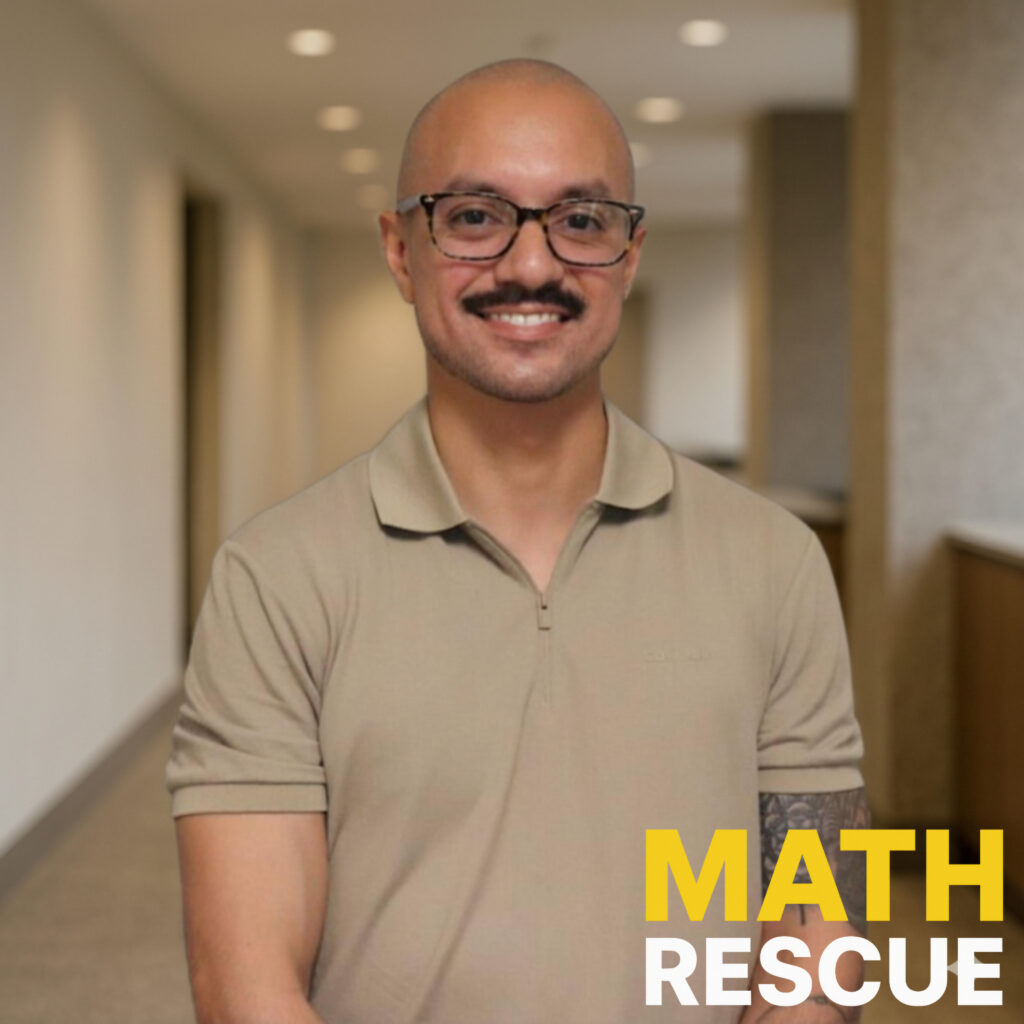
About Andre Vaquero, M.Ed.
Certified math educator and curriculum designer with advanced training in instructional technology. I’ve taught since 2017, both in-person and online, and specialize in turning abstract math into clear, visual steps students actually enjoy.
My mission is to help families build math confidence together — one skill at a time.
- B.S., Mathematics Education, 2017
- M.Ed., Curriculum and Instruction, specialization in math and instructional tech, 2019
- Graduate Certificate in Mathematics, 2021
- Classroom teaching since 2017, virtual teaching since 2021
I help middle school, high school, and college students master the exact skills that block progress, then build durable habits parents and students can sustain at home.
Serving families in St. Petersburg and online nationwide.