
If your child is applying to a private school, there’s a good chance an entrance exam is part of the process, and the math sections are where a lot of strong students get caught off guard. This guide covers SSAT math prep and ISEE math prep: what’s actually on each test, the one rule that changes everything (no calculators), and how I help students prepare.

SSAT or ISEE: which one does your child need?
It depends on the school. Here in Tampa Bay, for example, Tampa Prep asks applicants to grades 6 through 9 to take the SSAT, while Shorecrest accepts either the SSAT or the ISEE from applicants who don’t already have recent standardized scores. I cover both schools in detail on my Tampa Prep math tutor and Shorecrest math tutor pages. Always check each school’s admissions page first.
What the math sections look like
Here is how the math compares, from the SSAT and ISEE official pages:
| Test and level | Math sections | Questions and time | Calculator |
|---|---|---|---|
| SSAT Middle Level (grades 5–7) | Quantitative, two parts | 25 questions in 30 minutes, twice | Not allowed |
| SSAT Upper Level (grades 8–11) | Quantitative, two parts | 25 questions in 30 minutes, twice | Not allowed |
| ISEE Lower Level (grades 5–6) | Quantitative Reasoning / Mathematics Achievement | 38 in 35 min / 30 in 30 min | Not allowed |
| ISEE Middle Level (grades 7–8) | Quantitative Reasoning / Mathematics Achievement | 37 in 35 min / 47 in 40 min | Not allowed |
| ISEE Upper Level (grades 9–12) | Quantitative Reasoning / Mathematics Achievement | 37 in 35 min / 47 in 40 min | Not allowed |
The two ISEE sections test different things. Quantitative Reasoning is about logic and number sense, with little calculation. Mathematics Achievement tests the skills students have learned in school and does involve working problems out.
SSAT math topics: what’s on the Middle and Upper Level
The SSAT’s official guide lists the areas its math questions come from. The Middle Level (grades 5–7) and Upper Level (grades 8–11) share the same list, except for two topics that appear only on the Upper Level: coordinate geometry and slope. Otherwise the levels differ mostly in how hard the questions get.
Numbers and operations
- Adding, subtracting, multiplying and dividing, including fractions, decimals and negative numbers
- Word problems with percents and ratios
- Estimation
- Absolute value
- Properties of exponents
Algebra
- Algebra word problems
- Patterns, sequences and series
- Equations of lines
- Slope (Upper Level only)
Geometry and measurement
- Area and circumference of a circle
- Area and perimeter of polygons
- Volume of a cube, a cylinder or a box
- Right, isosceles and equilateral triangles, including the Pythagorean theorem
- Parallel and perpendicular lines
- Coordinate geometry (Upper Level only)
Data and probability
- Reading tables and graphs
- Frequencies
- Trends and inferences
- Probability
Since the 2024–25 admissions season, the SSAT score report breaks math into five areas: Algebra, Geometry and Measurement, Data Analysis, Numbers and Operations, and Reasoning. After a practice test, that breakdown shows where the points went, which makes it a good place to start.
The guide also notes that, depending on what a student has covered in school, some of these concepts may be unfamiliar. That’s normal, especially for younger students on the Middle Level, and it’s a big part of what prep is for.
The ISEE draws on the same broad areas: numbers and operations, algebra, geometry, measurement, data analysis and probability, and problem solving.
The rule that changes everything: no calculators
Neither the SSAT nor the ISEE allows calculators (except as an approved accommodation). That’s a big contrast with the digital SAT, which has Desmos built in. A student who is excellent in class but reaches for a calculator for every fraction or percent can lose a lot of time here.
So the heart of good SSAT math prep (and ISEE math prep) isn’t memorizing tricks. It’s fluency: fractions, decimals, percents, ratios, estimation and mental arithmetic that feel automatic, so a student can spend their time on the reasoning instead of the arithmetic.
Example SSAT math questions, and how I work through them

These are my own practice questions, written in the style of the SSAT: five answer choices and no calculator. Try each one before reading the explanation.
1. A jacket costs $40. It’s on sale for 25% off, and a coupon takes another 10% off the sale price. What is the final price?
(A) $24 (B) $26 (C) $27 (D) $30 (E) $35
Answer: (C) $27. 25% off $40 is $30. Then 10% of $30 is $3, which leaves $27. The trap is (B): adding the discounts to get 35% off. When a student picks it, I ask what the 10% is taken from. Once they say “the sale price,” they can see why the two discounts don’t simply add up.
2. Which of these is the greatest?
(A) 3/5 (B) 5/8 (C) 0.6 (D) 7/12 (E) 0.59
Answer: (B) 5/8. 3/5 and 0.6 are the same number, so neither one can be the single greatest. 5/8 is 0.625, and 7/12 is a little less than 0.6. Without a calculator, the fastest way is to know a few fractions by heart (the eighths are worth memorizing) and compare everything to them.
3. A circle has a circumference of 10π. What is its area?
(A) 5π (B) 10π (C) 20π (D) 25π (E) 100π
Answer: (D) 25π. Circumference is 2πr, so 2πr = 10π and the radius is 5. The area is πr² = 25π. Students who pick (E) used 10 as the radius, so my first question is: “Is 10 the radius or the diameter?”
4. (Upper Level) A line passes through the points (2, 3) and (6, 11). Where does it cross the y-axis?
(A) (0, −1) (B) (0, 1) (C) (0, 2) (D) (0, 3) (E) (0, 5)
Answer: (A) (0, −1). The slope is (11 − 3) ÷ (6 − 2) = 2, so y goes up 2 every time x goes up 1. To get from x = 2 back to x = 0, go back 2 steps, which takes y down 4: from 3 to −1. No equation needed, which saves time with no calculator.
One more thing about guessing. On the Middle and Upper Level SSAT, a wrong answer costs a quarter of a point and a blank costs nothing (how the SSAT scores guesses). A blind guess doesn’t help on average, but if a student can rule out even one choice, guessing among the rest comes out slightly ahead on average. We practice making that call quickly.
How I approach SSAT math prep
- Find the real gaps first. A short diagnostic shows which topics are solid and which ones are slowing a student down.
- Build fluency without a calculator. We practice the core skills until they’re quick and reliable.
- Practice under real timing. 25 questions in 30 minutes is a pace students have to rehearse.
- Review mistakes by asking questions. I teach Socratically, so instead of just showing the right answer, I ask what the student noticed and why they chose their approach. That’s what makes the next question go better.
Nerves are real on test day, too. If your child tends to freeze on timed tests, my guide on helping a teenager with math anxiety is worth a read.
When to start
Work backward from the school’s deadline. Many schools, including Tampa Prep and Shorecrest, use February 1 as a key date, which puts the test itself in the fall or early winter. The ISEE can be taken once per testing season (fall, winter and spring/summer), up to three times a school year, and the SSAT offers paper, at-home and test-center options. Starting a couple of months before the test date leaves time to build skills and still retest if needed.
SSAT and ISEE math FAQs
Q: Can you use a calculator on the SSAT or ISEE?
A: No. Neither test allows calculators on the math sections, except as an approved testing accommodation.
Q: How many math questions are on the SSAT?
A: Both the Middle and Upper Level SSAT have two quantitative sections of 25 questions each, with 30 minutes per section.
Q: What math topics are on the SSAT?
A: Arithmetic (including fractions, decimals, percents and ratios), algebra, geometry and measurement, and data and probability. Coordinate geometry and slope appear only on the Upper Level.
Q: Is SSAT math hard?
A: Most of it is middle school math, but with no calculator, a pace of 25 questions in 30 minutes and a quarter-point penalty for wrong answers, it can feel harder than schoolwork. Younger students may also see topics they haven’t covered in class yet.
Q: What is the difference between ISEE Quantitative Reasoning and Mathematics Achievement?
A: Quantitative Reasoning tests logic and number sense with little calculation. Mathematics Achievement tests the math skills students have learned in school and requires working problems out.
Q: How many times can my child take the ISEE?
A: Students may take the ISEE once per testing season (fall, winter and spring/summer), for up to three times a school year.
Q: Do you offer SSAT and ISEE math prep online?
A: Yes. All of my sessions are one-on-one on Zoom, with a shared whiteboard, so families anywhere can work with me.
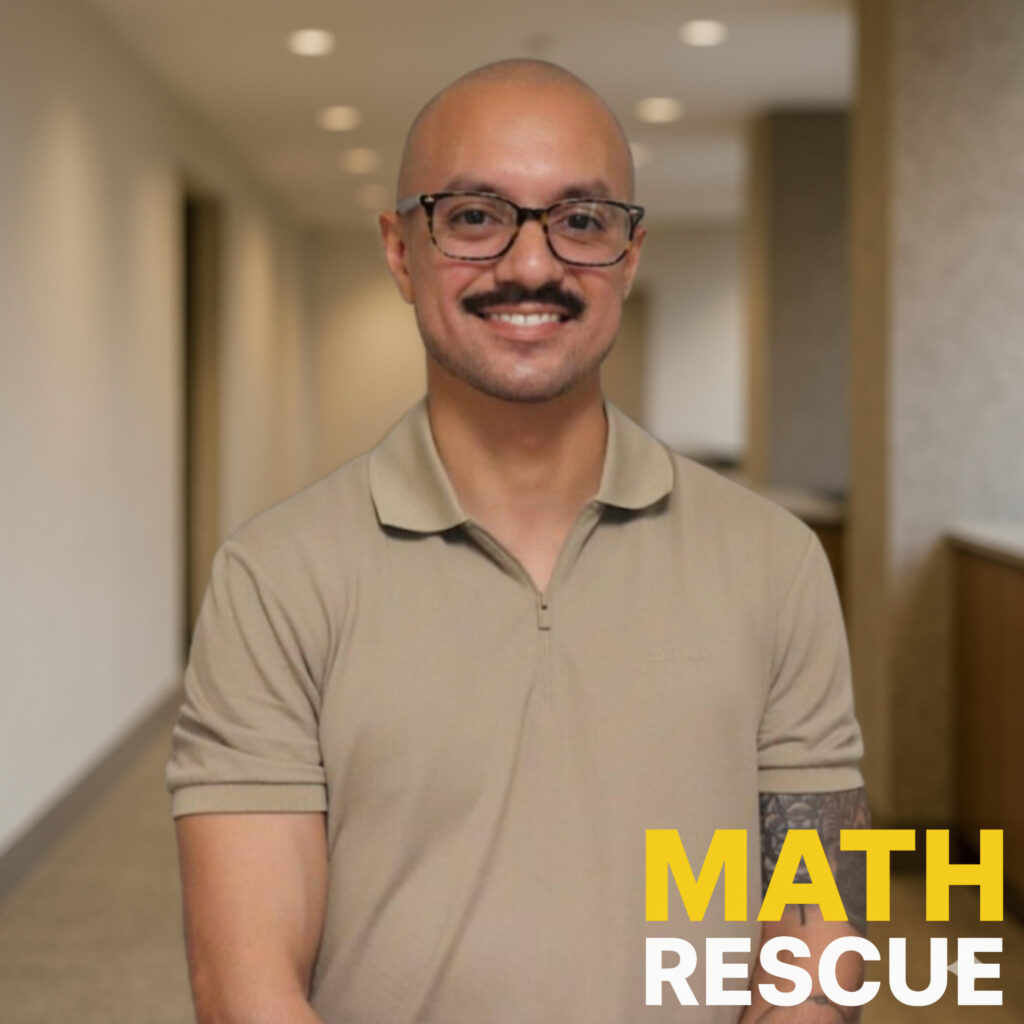
About Andre Vaquero, M.Ed.
Certified math educator and curriculum designer with advanced training in instructional technology. I’ve taught since 2017, both in-person and online, and specialize in turning abstract math into clear, visual steps students actually enjoy.
My mission is to help families build math confidence together — one skill at a time.
- B.S., Mathematics Education, 2017
- M.Ed., Curriculum and Instruction, specialization in math and instructional tech, 2019
- Graduate Certificate in Mathematics, 2021
- Classroom teaching since 2017, virtual teaching since 2021
I help middle school, high school, and college students master the exact skills that block progress, then build durable habits parents and students can sustain at home.
Serving families in St. Petersburg and online nationwide.