
Algebra Foundations
Why Factoring Is the Keystone of Algebra 2
Factoring is not just another skill in Algebra 2: it’s the skill. It connects products, patterns, polynomials, and nearly every rational or structural concept students face for the rest of high school math.
The Backbone of Algebra 2
Factoring sits at the heart of Algebra 2. It starts with recognizing products between numbers, then grows into greatest common factors, trinomial quadratics, and special factoring cases. But the critical milestone is factoring trinomials. Especially, understanding the difference between a = 1 and a ≠ 1.
That subtle distinction becomes a litmus test. Students who can see it, name it, and adapt to it are organizing skills into a lasting mental framework. Those who can’t are often patching short-term memory together problem by problem.
Why Some Students Struggle
In many cases, the barrier isn’t intelligence—it’s attention. The single biggest predictor I’ve seen for success in factoring is a student’s willingness to truly focus. We drill repetition hoping practice will produce clarity, but unless the student is mentally present during the early pattern recognition phase, the structure never cements.
Students who “kind of get it” can temporarily replicate the steps, but the moment they meet a new context, like rational expressions or polynomial division, they collapse. And it’s no mystery why: those chapters depend on factoring as the opening move. Without it, every new concept looks like murky magic.
Two Completely Different Algebra 2 Experiences
To the student who can’t: Algebra 2 is chaos. It is longer, more abstract, and increasingly mysterious.
The difference isn’t ability; it’s foundation. When factoring is second nature, rational equations, function analysis, and polynomial graphs all collapse back into manageable patterns. When it’s not, every new chapter feels like an uphill climb with no footholds.
Teaching Factoring the Right Way
In a perfect world, we could just transfer conceptual understanding directly into a student’s head. Since that’s not possible, the next best thing is to make students outline and teach the process themselves.
- Peer teaching: Have students create an annotated example set to explain to a partner. Teaching forces clarity.
- Proof framing: Move away from “solve this” and toward “show why this works.” Ask for justification at each step.
- Visual grouping: Color-code factor pairs or use algebra tiles to make structure visible.
- Personal narration: Have students record a short video or ChatGPT conversation explaining their reasoning for factoring choices.
Factoring, at its core, is pattern recognition paired with reasoning. The more students verbalize and externalize their logic, the faster they move from mechanical steps to conceptual fluency.
Final Thought
Every math teacher knows the moment when factoring “clicks” for a student. Suddenly, everything downstream makes sense. My goal isn’t just to make students good at factoring; it’s to make them see it as the universal key that unlocks the rest of Algebra 2. Because once they hold that key, the course stops feeling like magic and starts feeling like logic.
Get 1-on-1 Help
Watch the Factoring video
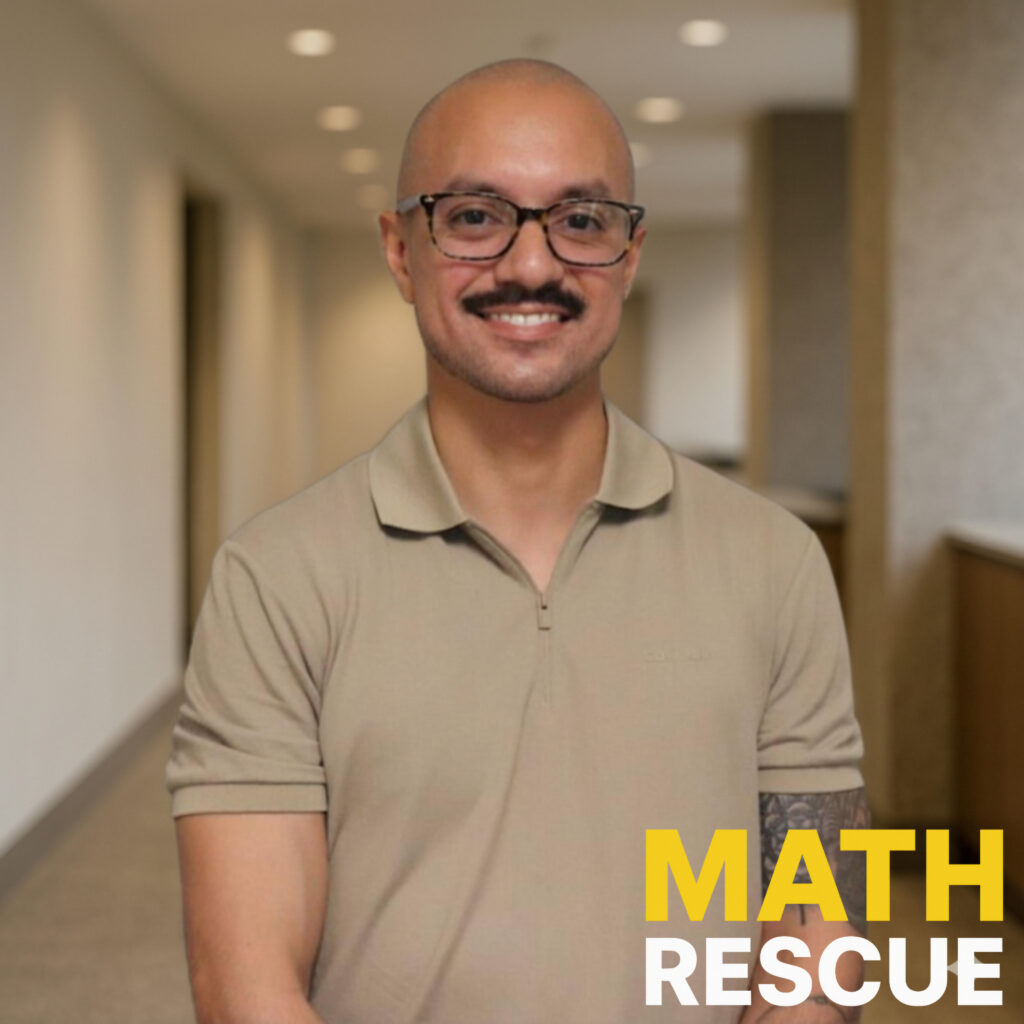
About Andre Vaquero, M.Ed.
Certified math educator and curriculum designer with advanced training in instructional technology. I’ve taught since 2017, both in-person and online, and specialize in turning abstract math into clear, visual steps students actually enjoy.
My mission is to help families build math confidence together — one skill at a time.
- B.S.Ed., Mathematics Education, 2017
- M.Ed., Curriculum and Instruction, specialization in math and instructional tech, 2020
- Graduate Certificate in Mathematics, 2022
- Classroom teaching since 2017, virtual teaching since 2021
I help middle school, high school, and college students master the exact skills that block progress, then build durable habits parents and students can sustain at home.
Serving families in St. Petersburg and online nationwide.